What the Rann is, and when it turns white
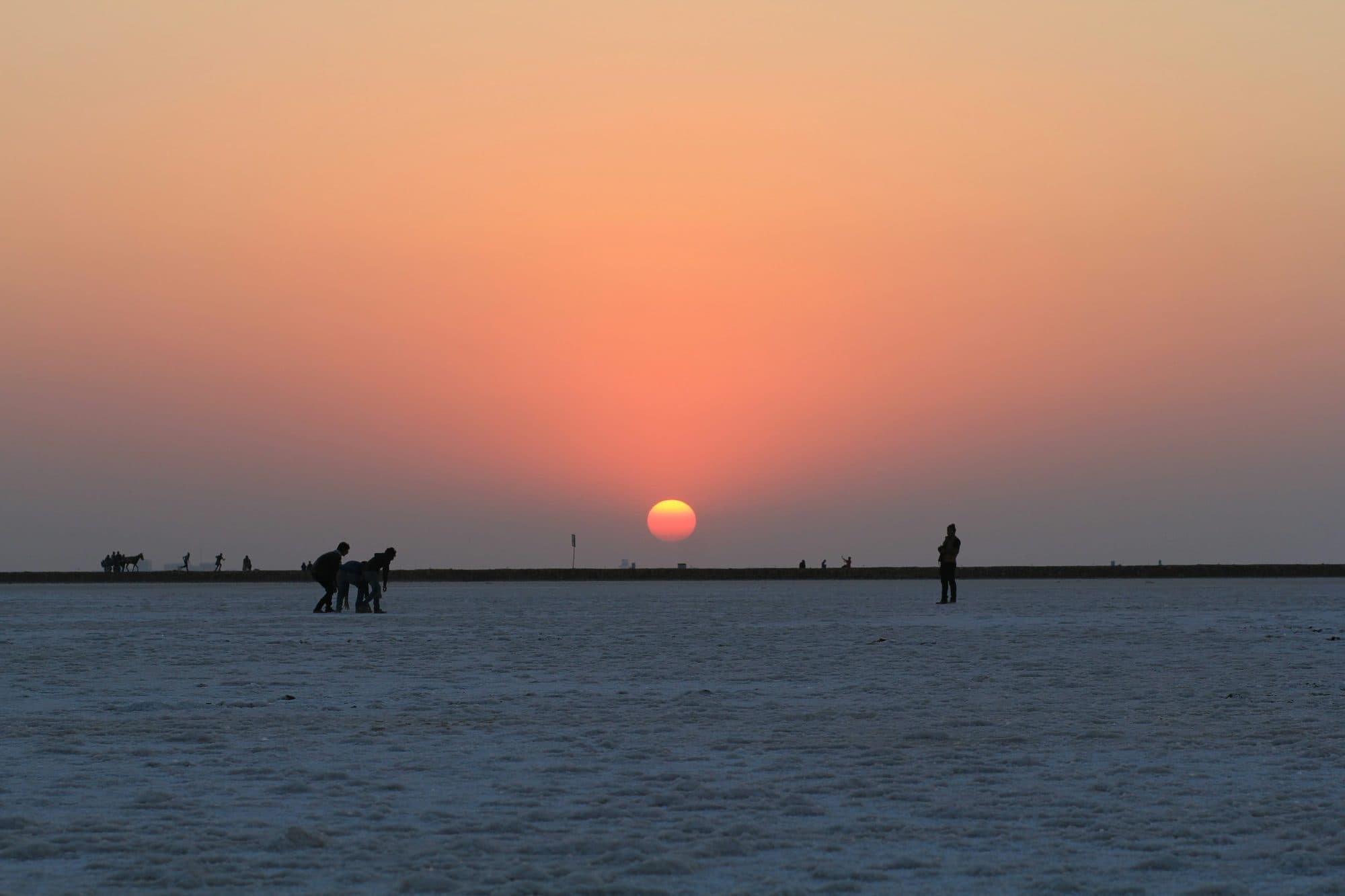
The Great Rann of Kutch is a seasonal salt marsh in the far north-west of Gujarat. It covers roughly 7,500 square kilometres of flat, low-lying ground in Kutch, the state's largest district, and stretches north to the border with Pakistan. In the monsoon, sea water and rain flood it; over the following months the water evaporates and leaves a crust of salt behind. That crust is the White Rann: a hard, white plain that runs to the horizon.
The month you go decides what you see. In most years the surface has dried enough to walk on by November, and the salt is at its whitest from about December to February. After a heavy monsoon the water takes longer to go and the white forms later than usual, so check recent reports before you fix your dates. By April the days are hot, and from about June to September the Rann is under water.
| When | What the Rann is usually like | Worth knowing |
|---|---|---|
| October | Still wet or muddy after the monsoon in most years | Too early for the White Rann |
| November | Drying, with the salt forming; wet patches after a heavy monsoon | The Rann Utsav usually opens; busy around Diwali |
| December to February | Dry and at its whitest; warm days, cold nights | Peak season: full moons and holidays usually sell out first |
| March | Salt still visible; days getting hot | The festival sometimes runs into early March |
| April and May | Very hot by day | Only early mornings and evenings are comfortable |
| June to September | Flooded by the monsoon | Not the season for the White Rann |
One name to keep apart: the Little Rann of Kutch, to the south-east, is a separate salt desert known for its sanctuary for the Indian wild ass. This guide is about the Great Rann and the White Rann at Dhordo. For the wider region, see our pages on the Rann of Kutch and Gujarat.
The Rann Utsav, the tent city and the permit
The Rann Utsav is Gujarat Tourism's winter festival at the edge of the White Rann. At its centre is a large tent city at Dhordo, the village nearest the main White Rann viewing area. The season usually runs from November to February, sometimes into early March. Gujarat Tourism announces the dates each year, so check them before you plan around the festival.
- Tents in several categories, usually sold as packages with meals. Check exactly what each package includes before you book.
- Evenings of folk music and dance, with craft stalls, food counters and activities that vary from season to season.
- Busy dates: full-moon nights, the Diwali holidays, Christmas and New Year usually sell out first.
You don't have to stay in the tent city to see the White Rann. Resorts and village stays near Dhordo work just as well, and the salt flat can usually be visited outside the festival dates too, with the same permit.
The White Rann permit
Everyone entering the White Rann needs a permit, and there is usually one for your vehicle too. You can apply online in advance on the Gujarat government's official permit portal, or get one at the checkpost at Bhirandiyara, on the road from Bhuj to Dhordo. Applying online saves queuing in the busy season. Carry the photo ID you applied with. International visitors should carry their passport and check the current process for foreign nationals before travelling, as rules in border areas can differ.
Bhirandiyara is known for mawa, a sweet made from slowly reduced milk, so the permit stop doubles as a snack stop. At the White Rann itself, you can walk out on to the salt from the entry point or take one of the camel carts that usually wait there. Check the current visiting hours if you want to stay for moonrise, and keep to the marked area: this is a border region, and instructions from the police and the Border Security Force apply.
Where to stay: tent city, bhunga or Bhuj
- The tent city at Dhordo, in Rann Utsav season: the closest you can sleep to the White Rann, with meals and evening programmes on site.
- Resorts and village stays near Dhordo and Hodka, many with rooms built as bhungas, the traditional round houses of the Banni grasslands: thick mud walls, a conical thatched roof and, often, mud-and-mirror relief work (lippan) inside. Their round shape is said to have stood up well in the 2001 earthquake.
- Hotels in Bhuj, about 85 km (1½–2 hours) from the White Rann: the practical base for the city's palaces, the craft villages and Mandvi.
For most trips we suggest one night in Bhuj and two near the Rann. That way you see the salt at sunset and again at sunrise or moonrise, without driving back to Bhuj in the dark.
Bhuj and the craft villages
Bhuj is Kutch's main town and the gateway to the Rann. Much of it was damaged in the earthquake of 26 January 2001 and has since been rebuilt. In the old palace quarter, the 18th-century Aina Mahal is known for its hall of mirrors, with the 19th-century Prag Mahal beside it. The Kutch Museum, and Smritivan, the earthquake memorial and museum on Bhujiyo hill that opened in 2022, are worth time too. Opening days and hours vary, so check before you go.
Kutch's crafts are the other reason to linger. Most are made in family workshops a short drive from Bhuj:
- Bhujodi (about 8 km south-east of Bhuj): weaving. Families of weavers work pit looms to make shawls, stoles and rugs, and many will show you how.
- Ajrakhpur (about 15 km east): ajrakh, a cloth block-printed in stages with resist pastes and natural dyes such as indigo and madder. The Living and Learning Design Centre here has a crafts museum.
- Nirona (about 40 km north-west): rogan painting, in which a thick paste of boiled castor oil and pigment is drawn out on cloth with a metal stylus. The craft is kept alive by one extended family; the village also makes bells and lacquerwork.
- The Banni villages around Dhordo and Hodka: embroidery and mud-and-mirror work, often sold from the home where it was made.
Workshops are often people's homes. Ask before you photograph anyone, and buy from the maker when you can: you see the work being done, and the money stays with the family.
Kalo Dungar, Dholavira and Mandvi
Kalo Dungar
Kalo Dungar, the Black Hill, is the highest point in Kutch at about 462 metres, and from the top you look out across the Great Rann. It lies about 25 km beyond the town of Khavda, roughly 100 km from Bhuj, and pairs easily with a stay at Dhordo. At the Dattatreya temple on the summit, the priests keep an old tradition of offering prasad (blessed food) to the local jackals after the evening aarti, the lamp ceremony.
Dholavira
Dholavira is a city of the Harappan, or Indus Valley, civilisation on Khadir Bet, an island in the Great Rann, and a UNESCO World Heritage Site since 2021. Its system of reservoirs and channels for storing water is the thing to see, and the site museum helps you make sense of the ruins. By the usual road through Bhachau and Rapar it is about 220–250 km from Bhuj (4½–6 hours each way), so it is a long day out, and many travellers stay a night nearby instead. A newer road across the Rann from Khavda, popularly called the Road to Heaven, shortens the journey from the Dhordo side; it runs through a border area, so ask about current access before planning around it.
Mandvi
Mandvi, about 60 km south-west of Bhuj (1–1½ hours), is an old port on the Gulf of Kutch. Its shipyard still builds large wooden dhows by hand on the riverbank, and close by are a long beach and the Vijay Vilas Palace, built in the early 20th century. Dabeli, Kutch's spiced potato filling in a soft bun, is said to have been invented here.
Getting there and what to pack
- By air: Bhuj has an airport with a small number of domestic flights, so check current schedules. Ahmedabad has many more flights and is a day's drive away.
- By rail: Bhuj has trains from Ahmedabad and Mumbai, among other cities, including overnight services.
- By road: Bhuj is about 330 km from Ahmedabad (5½–7 hours), and Dhordo is about 85 km beyond Bhuj (1½–2 hours). Distances inside Kutch are long and public transport is thin, so a car with a driver makes the trip far easier.
What to pack
- Layers. Winter days on the Rann are warm and sunny, but nights can be cold, especially in December and January. Bring a warm jacket or shawl for sunrise and evenings on the salt.
- Sun protection. The salt reflects the light, so sunglasses, a hat and sunscreen help even in winter.
- Comfortable closed shoes for the salt crust, which can be uneven or damp in places.
- Lip balm and moisturiser for the dry air.
- Photo ID for the permit, and some cash: ATMs and card machines are fewer once you leave Bhuj.
A sample four-day plan
This plan suits a winter trip that starts and ends in Bhuj, and every day can be changed. For a ready-made starting point, see our Rann of Kutch tour.
| Day | Plan | Night |
|---|---|---|
| 1 | Arrive in Bhuj by air or rail, or drive from Ahmedabad (about 330 km, 5½–7 hours). If there's time, the Aina Mahal and Prag Mahal, or Smritivan on Bhujiyo hill. | Bhuj |
| 2 | Morning with the rogan painters of Nirona, then on through the Banni grasslands to Dhordo, collecting your permit at Bhirandiyara if you haven't applied online. Sunset on the White Rann. | Near Dhordo |
| 3 | Sunrise on the salt if you're up for it. Kalo Dungar for the view over the Rann, then embroidery in the Banni villages. Back on the salt for moonrise or the stars. | Near Dhordo |
| 4 | Drive back to Bhuj (about 85 km, 1½–2 hours) and visit the weavers of Bhujodi and the ajrakh printers of Ajrakhpur, then fly or take the train onward. | — |
With a fifth day, add Mandvi and its shipyard, or a night near Dholavira. If you're driving back to Ahmedabad, add a night in Bhuj rather than doing the craft villages and the long drive on the same day. To join Kutch to the rest of the state, see our Gujarat tour plan and the Ahmedabad and Statue of Unity tour.
Planning your Kutch trip
If you'd like help with dates, permits and where to stay, get a quote for a private Kutch trip with a car and driver, and we'll suggest a plan that fits the season and the moon.